

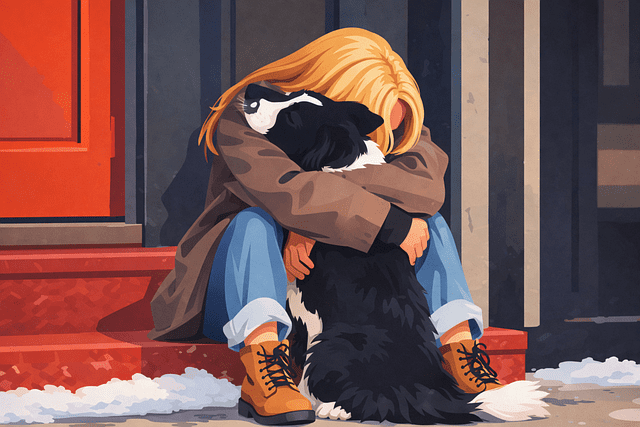
Ok, let’s delve right in. What’s up with the fanatical dependency on animals for one’s mental health? Speaking as an animal lover, and on behalf of animals, I am just a tad concerned. It appears that people are using animals as emotional scapegoats – for whatever reason, I don’t know why – but it is somewhat peculiar to me. People push their pets in baby carriages, paint their nails, and put diapers on them. There are pet spas, pet babysitters, pet psychologists, pet massage therapist’s, pet behaviorists, pet clothing stores, … the list goes on and on. Even today legislation is being submitted so that pets can be classified as dependants on our taxes. Has the world gone mad? Well, at least I am glad of one thing, people are not eating them.
While writing this article, many side trajectories became apparent. So, let’s just say, I will be saving many of them for future blogs. The main focus of this particular blog is in identifying the two sides of the animal assisted therapy coin. On the one side, animal-assisted therapy is viewed as being beneficial to mental health. On the other, it is viewed as destructive by allowing individuals to use animals as scapegoats so they can avoid dealing with every day issues. As an animal advocate and mother of four felines, I have personal familiarity of pets improving the overall quality of human life (i.e., providing some mental health benefits, assisting people who have a physical disability, enhancing the ability to live independently and to participate more fully in society), feeling it every day with ‘the loving’ that they provide. However, I was intrigued on the possibility of a flip side to something that I have experienced only in the positive. Lets just say, my eyes are now open.
The overwhelming concessus in learned circles is that animal assisted therapy is a great way to ‘improve’ the quality of our mental health. And why not, animals have been with us since we walked out of the bush on our own two feet; milling around for security, hunting, and companionship — forming deep relationships throughout the eons. Well, let’s face it, animals were always there — in our hearth’s and around them. With many different types of animals out there an equitable sense of co-dependency has been developed with a number of them, whether we wanted it or not. Or aware of it or not.
However, in the last 100 years, there seems to slow shift in how humans view animals; moving from a pure symbiotic/partnership function to that of an ’emotional support’ function. This shift ballooned in the 21st century where animals were elevated to having ‘human’ traits, rather than unique attributes; opposite from the earlier humans reverence on taking on animal traits attitudes to balance our weakness into strength. Today, animals are no longer recognized or even revered, but have been dumbed down to that of a miniature version of our infantile self — a mini me, so to speak.
In today’s world, Mental health services are rapidly increasing; parallel to this increase, mental health professionals have excessively recommended animal-assisted therapy for their clients with mental health problems. This expediency to place animals with people, seems a temporary ‘fix’ for social anxiety does not make sense to me; as I believe it is just replacing one potential vice with another. And as that classic fable by Aesop, “The Town Mouse and the Country Mouse,” even the endless treats may seem appealing, pleasant or beneficial, they often come with hidden costs and physical consequences, thus becoming pernicious. Thereore, as individuals struggle with the day to day living, trying to manage their mental health, it appears that many are self-medicating by keeping animals as a surrogate for human relations. And, as I believe that having animals is beneficial, humans can so easily sabotage their mental health by willingly removing themselves from human/human relationships, solely relying on animal/human emotional bonding and primal individual connections; especially now, in today’s age of wanting avoidance and technological isolation.
Orthodoxical Psychologists Arthur and Elaine Aron reference that humans attain positive mental maturity by utilizing a fundamental drive to grow and expand identity by acquiring new skills, knowledge, and perspectives. They demonstrated that when humans are in close relationships with other humans, individuals tended to incorporate aspects of their relations into their own self-concept—a process called “inclusion of the other in the self”. In other words, individuals who work with other humans were able to break new grounds in ideas, theories, perspectives and in building their own identities. It was further discussed that that it is with human/human social relationships that human entire well-being increases, and loneliness and mortality risks decreases (Animal (Based).2024 Jan 29:14(3):441).
Now I am not against, individuals having animals for mental health. One the one hand, it is important, as having a pet fulfills a number of benefificial mental health functions; if the animal is treated as an animal and not a human, and the individuals knows that they need to rely on other individuals along side their pets for mental health. On the other hand, animals as mental health pets, can also cause the reverse. It can create a sense of unfulfillment, further creating a mental health crisis, if the individual attributes more human-like qualities to their pets, thus relying on these animals for their main and only social support; destroying an individual’s social self-esteem because it relies on human to human contact, crucial to an individual’s psychological well-being.
Hence the two sided coin. What are your thoughts?